Overview
For community water projects, institutions, and organisations operating borehole systems in Kenya, operational costs particularly diesel fuel and grid electricity represent one of the largest and most unpredictable recurring expenses.
This case study documents how the Bondeni Community Water Project in Loitokitok, Kenya, transitioned from a conventionally powered borehole to a solar-powered system, and the measurable financial outcomes that followed.
The project was implemented in April 2023 through a collaboration between Africa In Store (AIS), GIZ, and Solargen.
Project Background
The Bondeni Community Water Project serves approximately 250 member households in Loitokitok, situated at the base of Mount Kilimanjaro in Kajiado County. The community has managed its own water infrastructure since 2006.
After earlier infrastructure challenges — including the loss of a pipeline system — the community drilled a borehole in 2019 to secure a reliable water supply.
While the borehole addressed water access, it introduced a persistent financial challenge: high and unstable operating costs driven by diesel consumption and electricity tariffs. Year on year, these costs consumed the community’s water fund, leaving no surplus for infrastructure maintenance or expansion.
The Operational Cost Problem
Diesel-powered and grid-connected borehole systems carry costs that compound over time:
- Fuel expenditure subject to global price volatility
- Grid electricity tariffs among the highest in sub-Saharan Africa for small consumers
- Generator maintenance — frequent servicing, parts replacement, downtime
- Operational risk — supply interruptions when fuel or power is unavailable
For the Bondeni community, these costs were not marginal. They represented the majority of annual water project expenditure, leaving no capacity to invest in system improvements or community development.
The Solar Transition: What Was Implemented
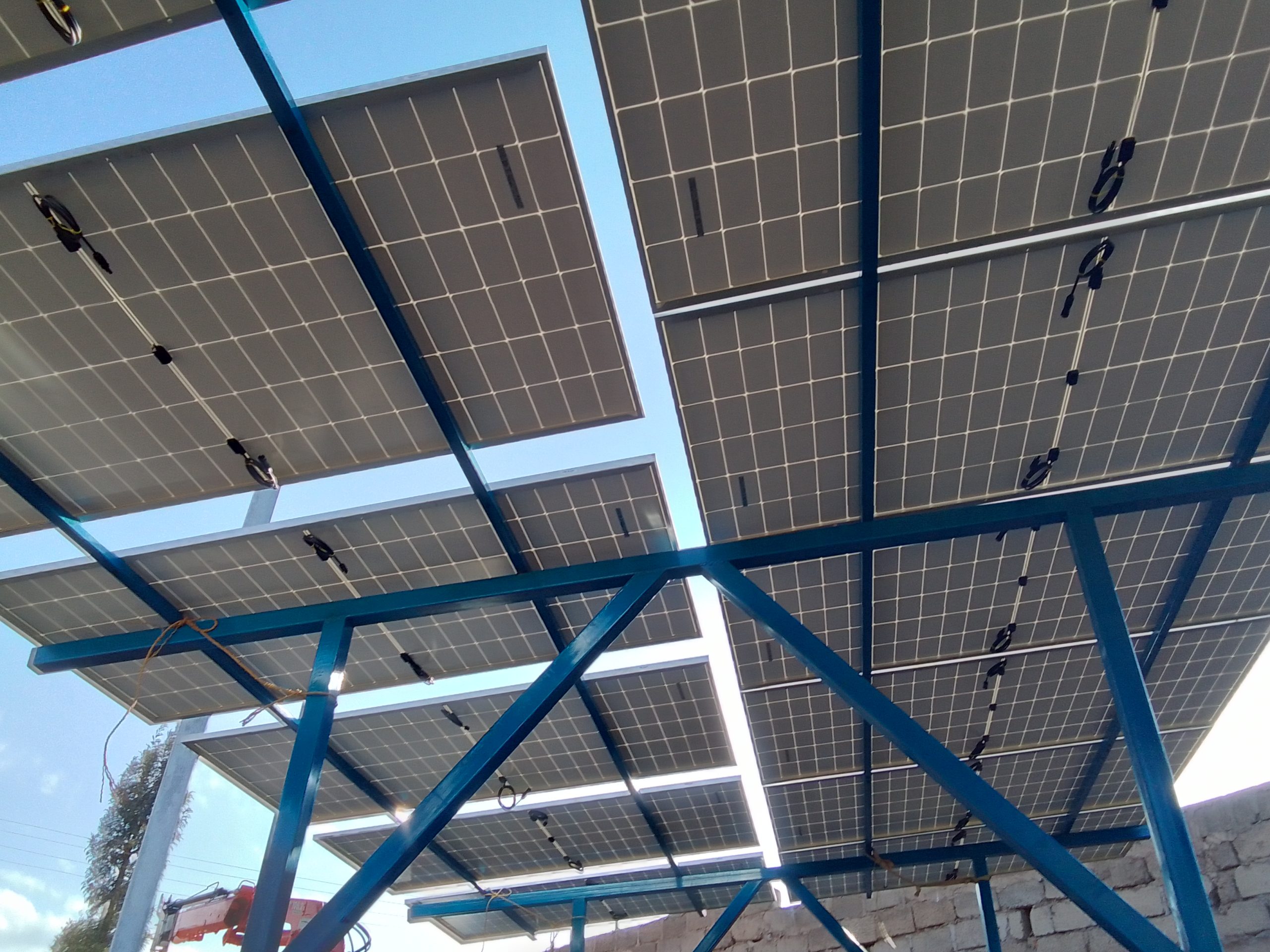
In April 2023, AIS, GIZ, and Solargen designed and installed a solar pumping system for the Bondeni borehole. The solution replaced diesel and grid dependency with a solar-powered pump system sized to meet the community’s daily water demand.
The installation covered:
- Solar photovoltaic array matched to pump load and site solar irradiance
- Solar pump controller and inverter
- Optimised submersible pump configuration
- Water storage to ensure supply continuity beyond daylight hours
- Structural mounting and full system commissioning
Financial Outcomes
The impact of solarization on the community’s finances was immediate and substantial.
Annual Savings
Following the solar transition, each member contributes Ksh 300 per month a contribution now directed primarily to savings rather than operational costs.
| Metric | Amount |
|---|---|
| Monthly contribution (250 members × Ksh 300) | Ksh 75,000 |
| Annual savings generated | Ksh 900,000 |
Capital Mobilisation for Infrastructure Expansion
With a reliable savings base established, the community initiated planning for a second borehole. Members made an additional one-time contribution of Ksh 10,000 each toward the new project.
| Metric | Amount |
|---|---|
| One-time member contribution | Ksh 10,000 |
| Total members | 250 |
| Capital raised for new borehole | Ksh 2,500,000 |
Total Financial Position Post-Solarization
| Description | Amount |
|---|---|
| Annual operational savings | Ksh 900,000 |
| Capital raised for expansion | Ksh 2,500,000 |
| Total available funds | Ksh 3,400,000 |
Before solarization, this level of financial capacity was not achievable. The solar transition did not only reduce costs — it created the conditions for infrastructure growth.
Why Solar Is the Stronger Operational Choice for Boreholes in Kenya
Kenya’s geography and energy landscape make solar an operationally superior solution for borehole systems in most contexts.
Energy cost reduction. Solar eliminates recurring fuel and electricity costs. Once installed, the system generates power at near-zero marginal cost for 25+ years.
Operational reliability. Solar pump systems operate independently of grid infrastructure, critical in rural and peri-urban areas where power supply is inconsistent.
Reduced maintenance burden. Solar systems have significantly fewer moving parts than diesel generators, resulting in lower maintenance frequency and cost.
Budget predictability. Fixed, minimal running costs allow water project administrators to plan budgets with greater accuracy and build reserves.
Scalability. Solar systems can be expanded as demand grows additional panels or higher-capacity pumps can be integrated without replacing the full system.
For organisations managing water infrastructure whether community cooperatives, county agencies, NGOs, or private institutions these are not marginal gains. They are structural improvements to operational efficiency.
Applicability: Which Organisations Should Consider Borehole Solarization
The Bondeni case is representative of a challenge faced across Kenya and the wider East Africa region. Solarization is a viable and financially sound option for:
- Community water projects with high diesel or electricity expenditure
- Agricultural cooperatives and irrigation schemes relying on diesel pumps
- Schools and health facilities with boreholes in off-grid or grid-unreliable locations
- County and national water supply infrastructure
- Development organisations and NGOs implementing water access programmes
- Private institutions — hotels, factories, estates — running diesel-dependent borehole systems
If your organisation is currently spending more than Ksh 50,000 per month on borehole power costs, a solar transition will likely deliver a full return on investment within 2–4 years.
Africa In Store: Solar Borehole Solutions for Organisations Across Kenya
Africa In Store (AIS) designs and delivers solar energy systems for institutional and community clients across Kenya and East Africa. AIS provides end-to-end project support — from site assessment and system design through to installation, commissioning, and long-term maintenance.
AIS borehole solarization services include:
- Technical site assessment and solar resource analysis
- Custom system design based on water demand and borehole specifications
- Supply of certified solar panels, pumps, controllers, and mounting systems
- Professional installation by accredited technicians
- Post-installation monitoring and maintenance support
- Access to green energy financing and grant programme guidance
AIS has delivered projects in partnership with international organizations, including GIZ, bringing both technical rigor and development sector experience to every engagement.
Request a Technical Assessment
If your organization is operating a diesel or grid-powered borehole, AIS can provide a technical and financial assessment of what solarization would deliver including projected cost savings, system specifications, and payback period.
This assessment is provided at no cost.
To initiate a consultation, contact the AIS team with the following information:
- Current monthly power/fuel expenditure for borehole operations
- Borehole depth and pump capacity (if known)
- Daily water demand
- Site location
📞 Contact AIS to schedule your borehole solar assessment. 🌐 Submit a project inquiry via the AIS website.
Frequently Asked Questions
What does borehole solarization typically cost in Kenya? System costs vary based on borehole depth, pump capacity, and daily water demand. Most community and institutional borehole solarization projects in Kenya range from Ksh 300,000 to Ksh 1,500,000. AIS provides site-specific cost estimates following a technical assessment.
What is the typical return on investment period? Organisations currently spending Ksh 50,000 or more per month on borehole power costs typically achieve full ROI within 2–4 years. The Bondeni community now generates Ksh 900,000 in annual savings a position that was not possible under their previous system.
Can solar systems power deep boreholes? Yes. Solar pump systems are engineered for borehole depths from 20 to over 150 metres. The solar array and controller are configured to match the specific hydraulic requirements of each site.
How is water supply managed at night or during low-sunlight periods? Solar borehole systems typically pump water into storage tanks during peak generation hours. Distribution continues from storage throughout the day and night. Battery-backup options are available for sites requiring continuous pumping.
How does solar compare to diesel operationally over a 10-year period? Over a 10-year period, a solar system will consistently outperform diesel on cost, reliability, and maintenance burden. Fuel price exposure is eliminated. Maintenance intervals are less frequent. System lifespan extends to 25+ years for panels.
Does AIS provide post-installation support? Yes. AIS offers maintenance agreements, technical support, and spare parts supply for all installed systems. Long-term system performance is a core component of the AIS service offering.
Can AIS support donor-funded or NGO-led water projects? Yes. AIS has direct experience working within donor-funded frameworks, including GIZ-supported programmes. The team can provide documentation, reporting support, and compliance guidance relevant to development sector procurement processes.